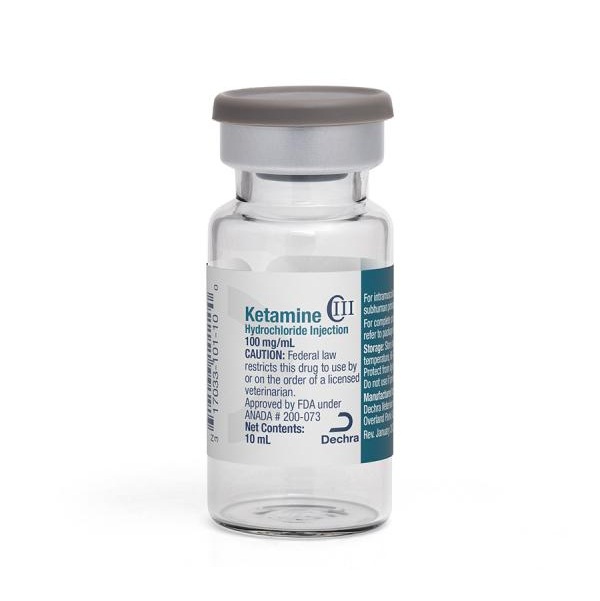
Ketamine Hydrochloride solution
£200.00
* The information on this page is a summary and is not intended to cover all available information about this medication. It does not cover all possible uses, directions, precautions, drug interactions or adverse effects and is not a substitute for the expertise and judgement of your healthcare professional.
Ketamine Hydrochloride solution
What is Ketamine
Ketamine Hydrochloride solution. Ketamine is a dissociative anesthetic used medically for induction and maintenance of anesthesia. Ketamine hydrochloride is also used for the treatment of depression and pain management in humans and animals. It is a novel compound that was derived from phencyclidine in 1962 in pursuit of a safer anesthetic with fewer hallucinogenic effects.
At anesthetic doses, ketamine induces a state of dissociative anesthesia, a trance-like state providing pain relief, sedation, amnesia. Ketamine’s distinguishing features as anesthesia are preserved breathing and airway reflexes, stimulated heart function with increased blood pressure, and moderate bronchodilation. At lower, sub-anesthetic doses, it is a promising agent for pain and treatment-resistant depression. As with many antidepressants, the results of a single administration decreases with time. The long-term effects of repeated use of ketamine hydrochloride solution are largely unknown, and are an area of active investigation.
Urinary and Liver toxicity have been reported among regular users of high doses of ketamine for recreational purposes. Ketamine is an NMDA receptor antagonist, accounting for most of its psychoactive effects on users.
Ketamine hydrochloride was first synthesized in 1962 and it was approved for it to be used in the United States of America in 1970. The drug is regularly used in veterinary medicine and was extensively used for surgical anesthesia in the Vietnam War. Along with other psychotropic drugs, it is on the World Health Organization’s List of Essential Medicines. It is available as a generic medication. When used as a recreational drug, it is found both in crystalline powder and liquid form, and is often referred to by recreational users as “Special K” or simply “K”. It is used as a recreational drug for its hallucinogenic and dissociative effects it has in humans.
Ketamine Dosage
Ketamine is supposed to be administered under the supervision of a doctor/physician. The initial dose of ketamine administered intravenously (IV) ranges from 1 mg/kg to 4.5 mg/kg. The average amount required to produce 5 to 10 minutes of surgical anesthesia is 2 mg/kg. The initial dose of ketamine administered intramuscularly (IM) ranges from 6.5 to 13 mg/kg. A dose of 10 mg/kg usually produces 12 to 25 minutes of surgical anesthesia. Ketamine hydrochloride may interact with barbiturates or narcotics. Tell your doctor all medications you use.
Uses of Ketamine Hydrochloride
Used as Anesthesia: The effect of ketamine on the respiratory and circulatory systems is different from that of other anesthetics. It suppresses breathing much lesser than most anesthetics being used. Ketamine is an option in children as the sole anesthetic for minor procedures or as an induction agent followed by neuromuscular blocker and tracheal intubation, In particular, children with cyanotic heart disease and neuromuscular disorders are good candidates for ketamine anesthesia .
When used at anesthetic doses, ketamine usually stimulates rather than depresses the circulatory system. Protective airway reflexes are preserved and it is sometimes possible to administer ketamine anesthesia without protective measures to the airways. Psychotomimetic effects limit the acceptance of ketamine however, lamotrigine and nimodipine decrease psychotomimetic effects and can be counteracted also by benzodiazepines or Propofol administration. Ketofol is a combination of ketamine and propofol medications.
Ketamine hydrochloride is frequently used as anesthesia in severely injured people and appears to be safe.
It has been widely used for emergency surgery in field conditions in war zones, for instance during the Vietnam War. A 2011 clinical practice guideline supports the use of ketamine as a sedative in emergency medicine, including during physically painful procedures. It is the drug of choice for people in traumatic shock who are at risk of hypotension. Ketamine is unlikely to lower blood pressure, which is dangerous for people with severe head injury, in fact it can raise blood pressure, often making it useful in treating such injuries.
Pain: Ketamine is used for acute pain treatment in emergency departments and in the perioperative period for individuals with refractory pain. These have lower doses than those used for anesthesia. They are usually referred to as sub-anesthetic doses. Adjunctive to morphine or on its own, ketamine reduces morphine use, pain level, nausea, and vomiting after surgery. Ketamine is likely to be most beneficial for surgical patients when severe post-operative pain is expected, and for opioid-tolerant patients.
Depression: Ketamine acts as an antidepressant, although its effect is transient. Intravenous ketamine infusion in treatment-resistant depression may result in improved mood within 4 hours reaching the peak at 24 hours. A single dose of intravenous ketamine has been shown to result in a response rate greater than 60% as early as 4.5 hours after the dose (with a sustained effect after 24 hours) and greater than 40% after 7 days. Even though there are only a few pilot studies studying the optimal dose, increasing evidence suggests that 0.5 mg/kg dose injected over 40 minutes gives an optimal outcome. The antidepressant effect of ketamine is diminished at 7 days, and most people relapse within 10 days, although for a significant minority the improvement may last 30 days or more. The greatest challenge with ketamine treatment can be the length of time that the antidepressant effects lasts after finishing a course of treatment. A possible option may be maintenance therapy with ketamine which usually runs twice a week to once in two weeks. Ketamine may decrease suicidal thoughts for up to three days after the injection.
Frequently asked questions
A seemingly elegant design can quickly begin to bloat with unexpected content or break under the weight of actual activity. Fake data can ensure a nice looking layout but it doesn’t reflect what a living, breathing application must endure. Real data does.
Websites in professional use templating systems. Commercial publishing platforms and content management systems ensure that you can show different text, different data using the same template. When it’s about controlling hundreds of articles, product pages for web shops.
A seemingly elegant design can quickly begin to bloat with unexpected content or break under the weight of actual activity. Fake data can ensure a nice looking layout but it doesn’t reflect what a living, breathing application must endure. Real data does.
Websites in professional use templating systems. Commercial publishing platforms and content management systems ensure that you can show different text, different data using the same template. When it’s about controlling hundreds of articles, product pages for web shops.




Reviews
Clear filtersThere are no reviews yet.